

Case Studies
Across ecosystems and landscapes — from rivers, coasts, and oceans to cities, farms, and forests — these case studies show how Nature-based Solutions deliver cost-effective climate resilience while restoring biodiversity, strengthening livelihoods, and integrating sustainable governance and planning.
Session 1 Nature-based Solutions in Riverine, Coastal and Marine Ecosystems
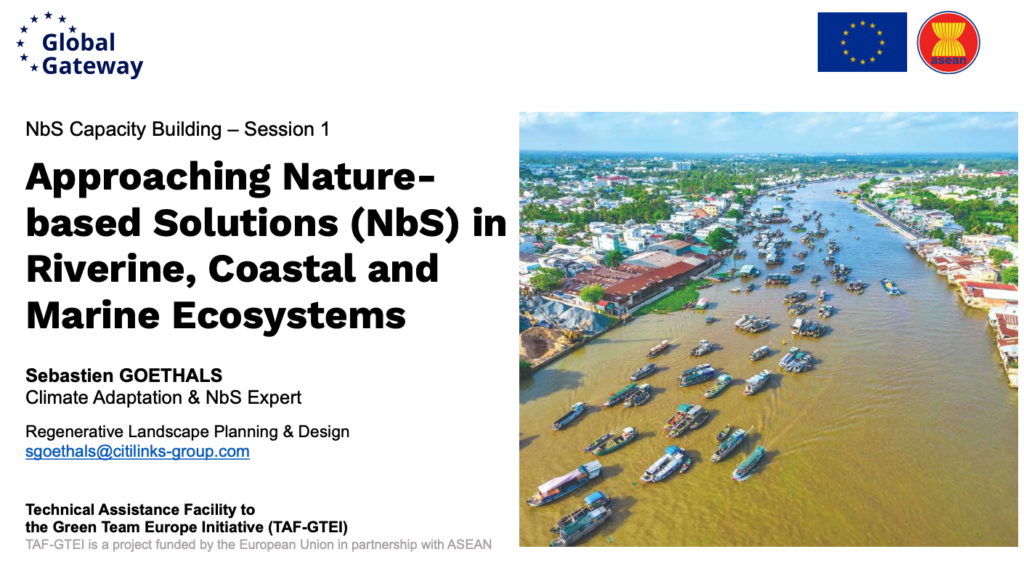
This session introduced how Nature-based Solutions (NbS) can be applied across riverine, coastal, and marine ecosystems in Southeast Asia to strengthen climate resilience while supporting biodiversity and livelihoods. It presented flood-responsive riverscapes, adaptive sandy shorelines, coastal mangroves, and regenerative seascapes as integrated landscape systems, drawing on examples such as wetland restoration, mangrove protection, sediment management, and blue carbon ecosystems. The session emphasised NbS as cost-effective, scalable approaches that deliver co-benefits for disaster risk reduction, water management, fisheries, and climate mitigation under integrated river basin, coastal, and marine governance frameworksgle page
Session 2 Nature-based Solutions in Urban and Industrial Environments
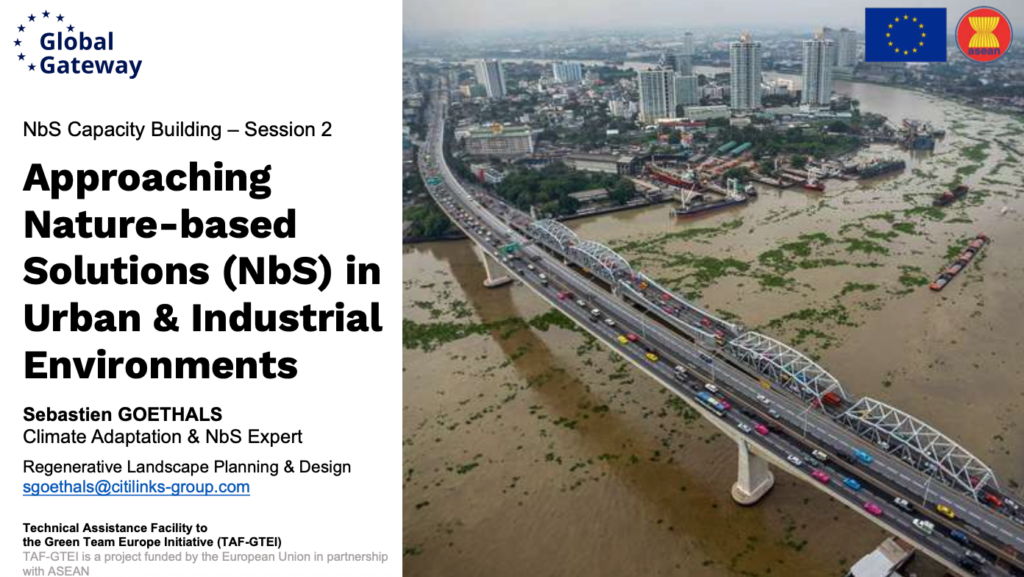
This session focused on applying NbS in cities, industrial zones, and ports to support climate-smart and resilient urban development. It explored the transition from grey to green infrastructure through approaches such as water-sensitive urban design, blue-green streets, urban wetlands, green roofs, and eco-industrial parks. Drawing on international case studies from Southeast Asia and Europe, the presentation highlighted how NbS can reduce flood and heat risks, improve livability, protect economic assets, and enhance urban biodiversity. It also outlined key institutional, policy, and financing enablers needed to mainstream NbS into urban planning and infrastructure systems.
Session 3 Regenerative Agriculture, Forests and Wildlife Corridors with NbS
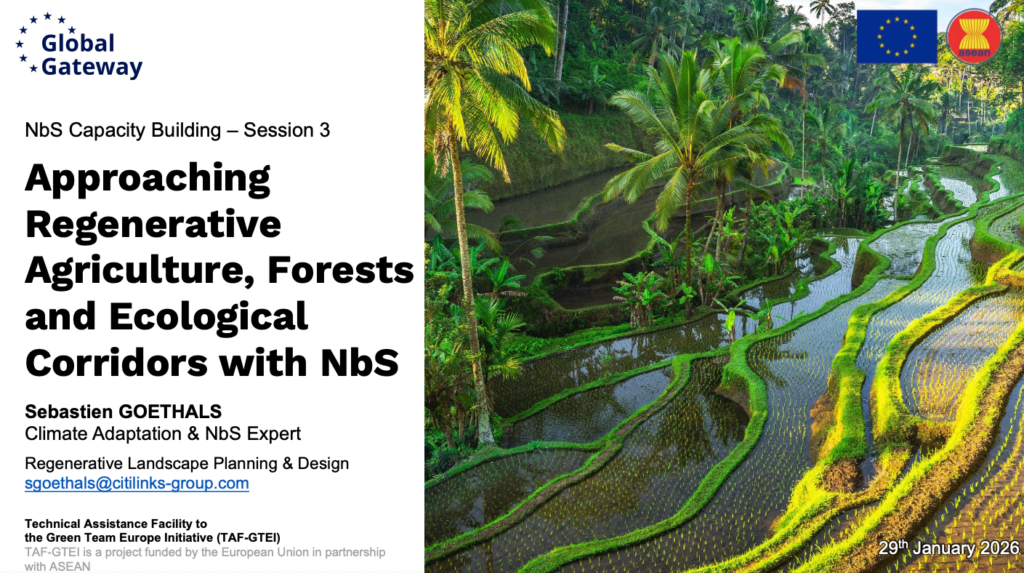
This session examined how NbS can drive regenerative agriculture, restore forests and natural habitats, and reconnect fragmented landscapes through ecological corridors. It showcased landscape-scale approaches that rebuild soil health, restore hydrology, recover biodiversity, and support rural livelihoods, with case studies from the Mekong Delta, peatland restoration in Indonesia, and protected forest landscapes. The session highlighted the role of NbS in addressing ecosystem degradation by integrating farming systems, forest restoration, and wildlife connectivity, supported by enabling policies such as land tenure security, ecosystem restoration concessions, payments for ecosystem services, and cross-border conservation cooperation.